International Patent Classification (IPC), administered by the World Intellectual Property Organization (WIPO), was established in 1971 to categorize all patents and utility models using symbols according to the various technical fields to which they belong. Each new publication such as patent application or utility model thus includes at least one IPC classification. The IPC structure is available free of charge on the WIPO website so that anyone can view the titles of the classifications currently in effect. This structure is updated on January 1st of each new year (see Version 2026 in the figure below).
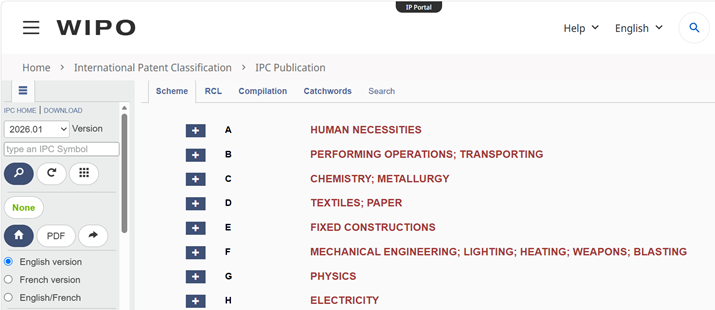
Extract from IPC publication scheme, Version 2026 (source: WIPO website)
Early 2013, an extension of the IPC was introduced jointly by the European Patent Office (EPO) and the United States Patent and Trademark Office (USPTO). This is the Cooperative Patent Classification (CPC, index available on Espacenet). The aim of the CPC is to preserve the fundamental structure of the IPC (sections, classes, subclasses, groups, and subgroups) while adding more specific details (specific codes, classifications related to application in a particular field, etc.). As of 2026, there are approximately 250,000 groups (or codes) in the CPC, compared to approximately 80,000 in the IPC.
Sources: https://www.epo.org/en/searching-for-patents/helpful-resources/first-time-here/classification/cpc https://www.wipo.int/classifications/ipc/en/ITsupport/Version20260101/transformations/stats.html
The various classification codes are defined according to the following structure (see the example in the figure below, taken from the CPC classification index): section (A), class (A63), subclass (A63B), main group (A63B 59/00), subgroup (A63B 59/50), and specific code (A63B 2059/581).
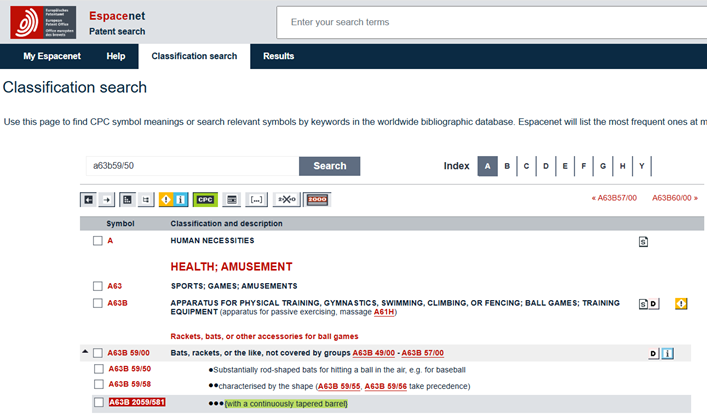
Extract from CPC classification browser (source: Espacenet)
With regards to classifications changes, WIPO updates the IPC through revision projects that may lead to the creation of new codes, which are then incorporated into the CPC and further detailed. The CPC is updated more regularly than the IPC (generally in January, May, and August) through the creation, deletion, or transfer of groups.
Several websites provide details on each update, including:
It should be noted that when a transfer is formalized between a classification “A” and a classification “B”, the patent offices (WIPO, EPO, USPTO) will update their databases (WIPO, Espacenet, European Patent Register, Open Data Portal) to replace the classification “A” with the classification “B” in the IPC and/or CPC sections. This applies not only to publications issued after the reclassification but also to earlier publications (in theory, all publications containing classification “A” should therefore eventually include classification “B”). There remains some uncertainty regarding the time required to complete the reclassifications following the introduction of new sections.
Naturally, over time, more and more new classifications have emerged to keep pace with technological advances. As for the IPC, there was a notable increase in the total number of IPC groups of approximately 14% between 2006 and 2023 (see the chart below, taken from a WIPO presentation published in November 2022).
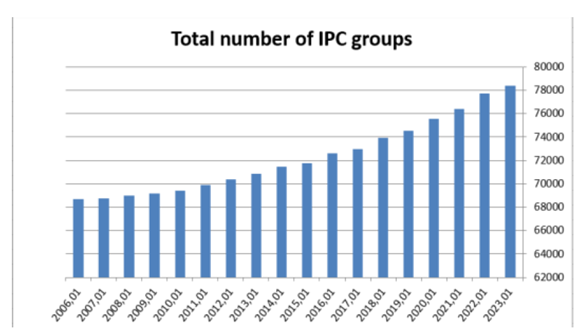
Changes in the number of IPC groups between 2006 et 2023 (source: “Recent development of International Classifications”, Kunihiko Fushimi & Alison Züger, WIPO, November 14, 2022)
These numerous changes to the IPC and CPC classifications have an impact on patent information specialists and those responsible for conducting searches in patent databases. Indeed, searching by classification codes is very useful, particularly for identifying patent documents in a specific field, regardless of the language of publication, thereby avoiding the use of generic keywords and their synonyms in multiple languages.
By following the creation, modification, and deletion of classifications, you can define new search strategies and/or update previously used queries. This will help optimize the relevance of search results to obtain more accurate statistics and even find a better prior art.
Let's now look at some examples of the main changes to the classification systems (IPC & CPC) that have taken place in recent years. Major developments over the past fifteen years have involved the following technical fields:
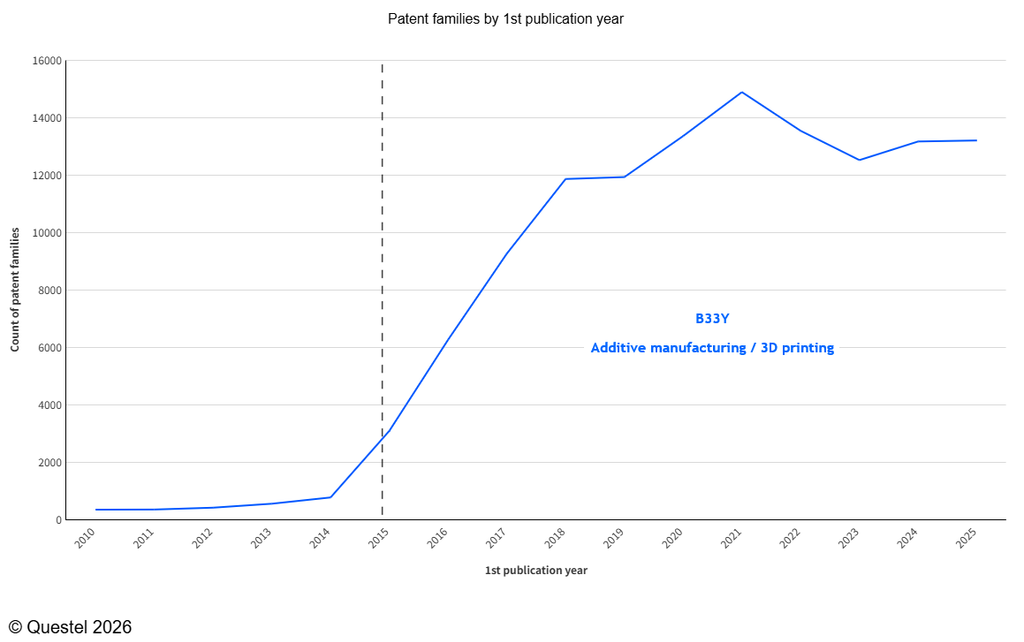
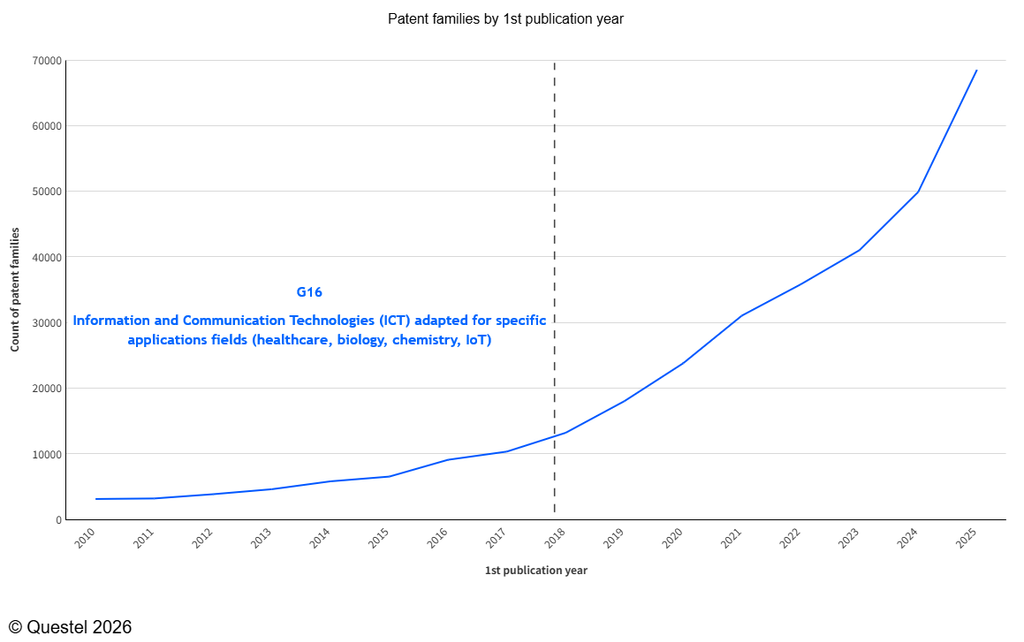
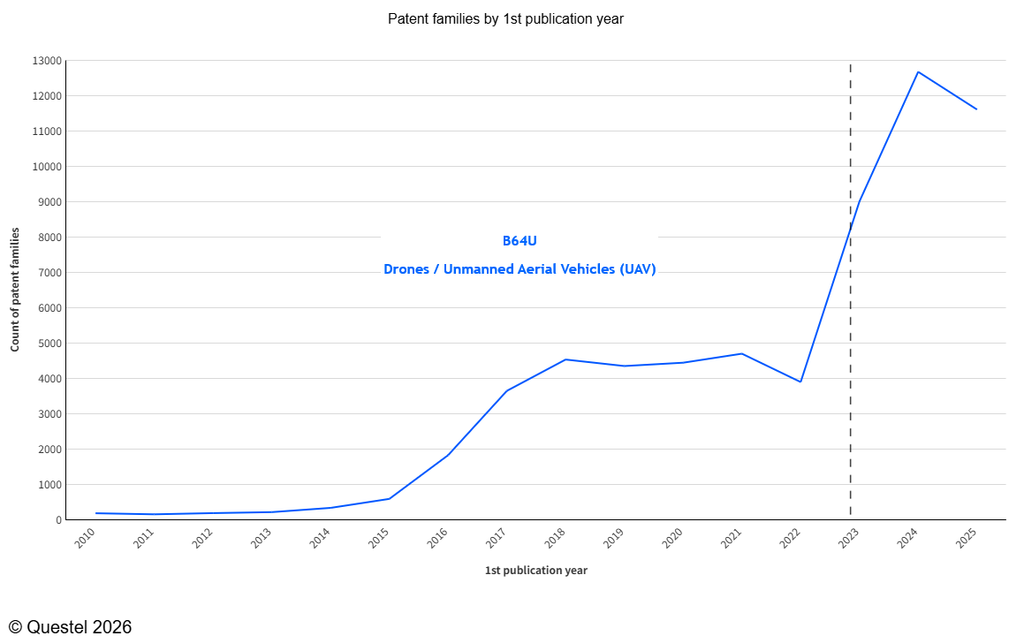
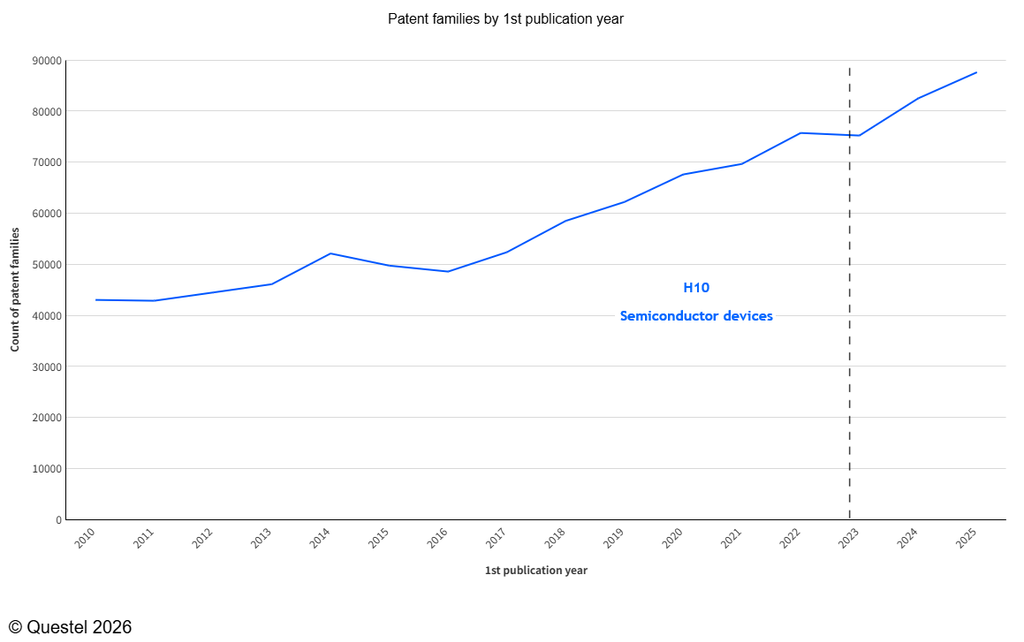
Temporal distribution of first publications of patent families between 2010 and 2025 for IPC-CPC classifications B33Y, B64U, G16 and H10, with the date the classification took effect shown as a dotted line (Source: Orbit Intelligence, Questel)
In these four technical fields, there has been a sharp increase in the number of first publications of patent families in the first few years following the entry into force of the new IPC/CPC codes. This confirms, on the one hand, that these are popular fields for patent protection and, on the other hand, that it is necessary to take these new classifications into account when conducting a search in patent databases within any of the relevant technical fields. The number of search results to review is therefore likely to be much higher!
Effective January 1, 2027, a brand-new IPC class dedicated to manipulators and robots will be introduced (B70). It will especially include subclasses related to exoskeletons (B70J) and robots (B70R), such as humanoid robots, animal-like robots, and service robots.
Finally, among the ongoing projects that may soon lead to the creation of new classes and/or reclassifications, the following technical fields are worth mentioning:
Patent classifications (primarily the IPC and CPC) are designed to organize all patented technical knowledge into sections corresponding to their technical fields—or even their fields of application—thereby facilitating prior art searches. To keep pace with technological developments over time, new classifications are regularly introduced, which may involve reclassifications from previous classification entries to new symbols. This has been the case in recent years with regard to 3D printing, IoT devices, drones and semiconductors.
Regimbeau IP Intelligence team is available to help you define appropriate search queries to monitor patent activity in your competitive environment and/or conduct prior art searches in your areas of interest.
Télécharger la publication


